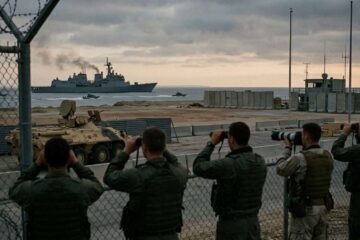

US–Iran Tensions Escalate Again as Fragile Deal Falters Over Hormuz Crisis
Oil prices have risen sharply amid renewed hostilities between the United States and Iran, signalling further strain on an already fragile diplomatic framework centred around the Strait of Hormuz. The recent escalation follows a series of tit-for-tat military exchanges that have cast uncertainty over ongoing negotiations.
At the core of the situation is a provisional understanding reached earlier this year, aimed at reopening the Strait of Hormuz, a critical global oil transit route, and reducing direct confrontation. However, the agreement has remained unstable, with both sides accusing each other of violations.
The latest flare-up began after an alleged Iranian drone strike on a commercial vessel in the strait. In response, the United States carried out airstrikes targeting Iranian military infrastructure, including drone and missile facilities. Iran retaliated with missile and drone attacks on US-linked military bases in the region, including in Bahrain and Kuwait, marking one of the most serious escalations since the interim deal.
Iran’s actions are being framed as retaliatory rather than pre-emptive. Officials in Tehran have maintained that attacks on US assets are a direct response to continued American strikes and perceived violations of sovereignty. The broader conflict also remains tied to unresolved issues including sanctions, maritime control, and Iran’s insistence on asserting authority over the Strait of Hormuz.
Diplomatic efforts have not entirely collapsed. Reports indicate that both countries have signalled willingness to resume talks, with negotiations expected to continue in neutral locations. However, repeated military exchanges have exposed deep mistrust and differing interpretations of the agreement.
With nearly a fifth of global oil supply passing through the strait, continued instability poses significant risks to energy markets and global trade, as well as the possibility of a wider regional conflict.